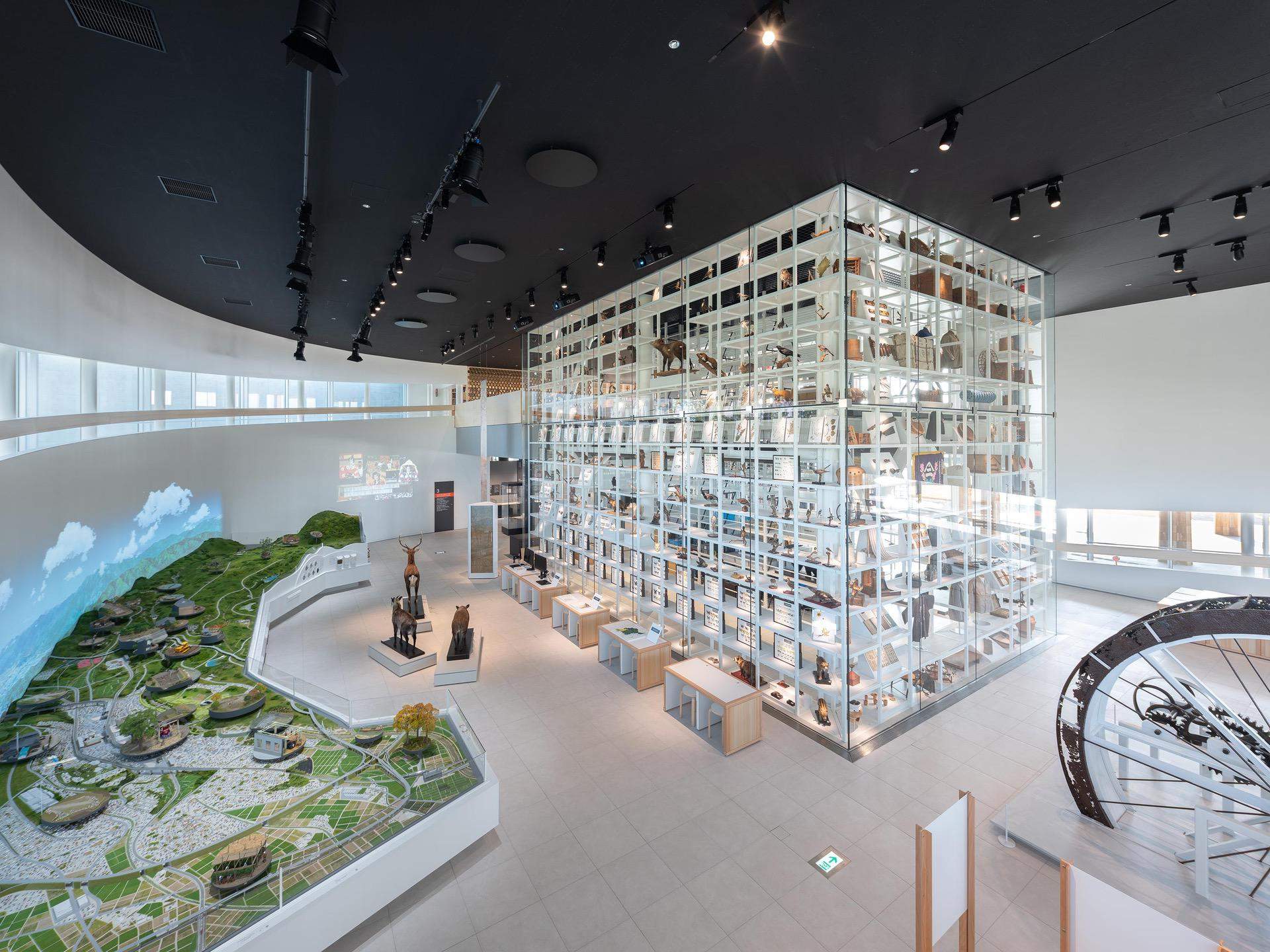
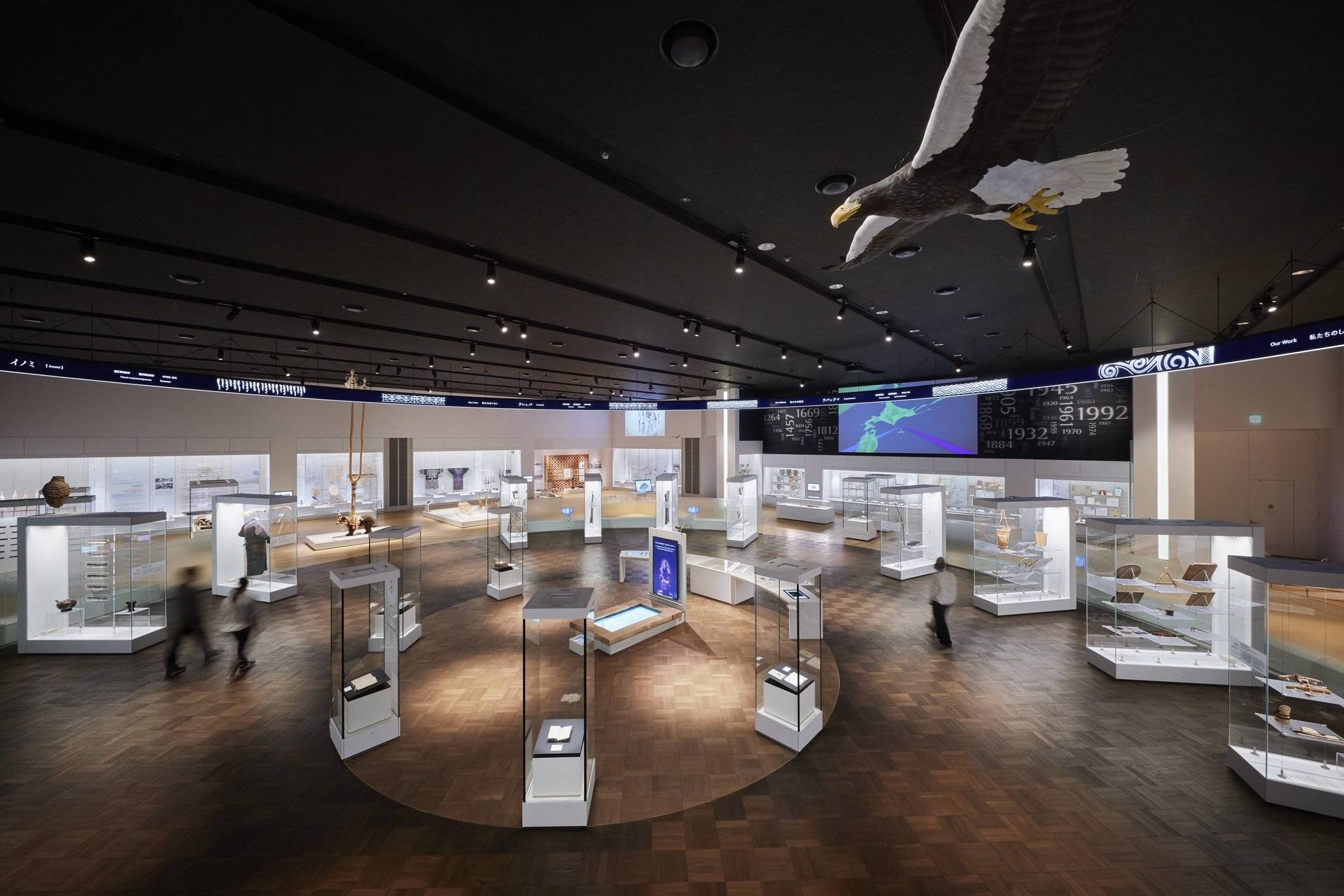
The exhibition “Diversification from a Common Origin – Four Historical Spaces and Times at the Pearl River Estuary” serves as a key cultural narrative carrier for the Nantou Ancient City Protection and Utilization Project in Shenzhen, and it has been open to the public since August 26, 2020. Diameter Narrative Design (DND) was entrusted by Vanke to fully oversee the curatorial and exhibition design of this exhibition.
Based on the policy positioning of Nantou Ancient City, we extend the “cognate” curatorial concept to the cultural characteristics of openness, diversity, inclusiveness, and convergence in the Pearl River Estuary region, and interpret it from four perspectives: “Mountain and Sea Sharing a Look,” “Economy as One,” “Culture Sharing a Heart,” and “Administration Belonging Together.” Facing the real difficulties of exhibition space conditions, exhibit conditions, and time constraints, the exhibition design direction is planned as “an artistic historical theme exhibition,” using the design concept of a “super flat” to reweave time and space, achieving a “panoramic” experience of content, space, and exhibits.


Curatorial Approach: From Historical Homologous Relationships to Exhibition “Homologous” Relationships
After more than half a year of curatorial research and multiple rounds of communication with experts, the Diameter Narrative team discovered that the “common origin” in the Pearl River Estuary region is fundamentally different from the commonly understood “common origin”. Based on the geographical feature of “three rivers converge and eight estuaries diverge”, this area is a melting pot of various ethnic groups such as Guangfu, Hakka, Fulao, and Danjia. Marine culture and mainland culture overlap here, and resources from China, Southeast Asia, and the West are traded here… Over time, through the continuous accumulation of history, an open, integrated, and rich cultural character has gradually emerged. Therefore, the “common origin” referred to in this exhibition signifies the rich and diverse social culture of the Pearl River Estuary region and the region’s inherent spirit of openness and inclusiveness as a “source”.
Spatial Comparison: Viewing An Exhibition From Within An Urban Village
Nantou Ancient City, with nearly two millennia of history, has gradually become a crowded urban village in need of renewal. The temporary exhibition occupies one of its few generous spaces. From the outset, we imagined a contrast for visitors entering from the bustling streets: an open, ordered and quiet interior set against the density and noise outside.


Design Strategy: Viewing The Exhibition From Inside The Museum
3.1 “Homologous Panorama”

This exhibition is not composed of numerous exhibits, but achieves the unity of spatial panorama, exhibit panorama, and content panorama through a panoramic exhibit. Firstly, the team did not use conventional methods such as setting up partitions to destroy the integrity of the space. Secondly, the “newspaper” matrix placed on the ground integrates all the information of the exhibition both in form and content. The installation and projection rely on the newspaper matrix to further respond to the theme, while expert interviews are discussions and dialogues extending from the newspaper. In addition, the infinitely looping trestle incorporates the walking audience into the exhibition.
3.2 Super Newspaper, Re-weaving Space-time

Generally speaking, the characteristics of newspapers are that the same theme can have different layouts and sections, diversified content formats, and the ability to traverse and edit through time and space. However, “super newspapers” can achieve multiple scales, dynamic images, three-dimensional illustrations, and electronic extension of content. Therefore, all elements in the entire exhibition hall become a part of it: from the ground to the space, from static to dynamic, from two-dimensional to three-dimensional, from the past to the present, and from the exhibition to the audience.
3.3 Jetty And The Sound Of Waves, A Return Of Emotions

The trestle is elevated a certain distance above the newspaper matrix, and speakers are installed beneath it. During the exhibition, visitors can hear the sound of the tide under the trestle, accompanied by flickering breathing lights, as if they were standing on the coast. The audio and visual interplay achieves a fusion of reason and emotion. The starting point beneath the visitors’ feet is also their ultimate return point, and their actions perfectly echo the theme of “homologous”.
3.4 Artistic installations, three-dimensional expression of thematic content
We have utilized artistic techniques to express the content of the newspaper in an installation-like manner. The following content provides an interpretation of the process of generating the installation.

Device 1: Review Of Meteorological Events
Perhaps we cannot witness the trillion-year evolution of time and space with our own eyes, and the lives of mountains and trees in nature exist independently of us, but the daily changes in weather and seasons are events we have personally experienced. The Pearl River estuary region happens to be one of the areas with relatively complex climate changes in the country. Therefore, we have extracted the content of extreme weather and re-edited the meteorological reports on key cities in this region through screen videos, evoking the shared memories of residents and viewers in this area.


Device 2: The Rights Space at Nantou
Salt held a very important position in ancient China, and the central government’s jurisdiction over Nantou began with the control of salt, which further extended to various aspects such as administration, coastal defense, economy, and military. Through this set of map installations, we showcase the changes in the jurisdiction of Nantou over history, allowing the audience to more clearly understand the institutional changes in the ancient eastern coastal region of the Pearl River Estuary centered around Nantou.


Device 3: The trade network at the Pearl River estuary during the Ming and Qing dynasties
All people in the world come for profit, and all go back to profit. During the Ming and Qing dynasties, factors such as the transition from tributary trade to merchant ship trade, the intertwined contradictions between private trade activities and imperial policies as well as local government regulations, and the marine and inland river trade radiating from the Pearl River Estuary jointly contributed to the trade frontier status of the Pearl River Estuary. We have created a three-dimensional network connection of the changing shipping routes during the Ming and Qing dynasties, hoping to give viewers a glimpse of the important role played by the Pearl River Estuary in world trade.


Device 4: Collective Memory of Different Ethnic Groups at the Mouth of the Pearl River
What constitutes a home? The native land is the eternal spiritual belonging of people. The Pearl River Estuary region is a melting pot of diverse ethnic groups, where Hakka people, Cantonese people, Tanka people, and Chaoshan people live and create the history of this region. The photo frame installations preserve their historical images from different periods. The Pearl River Estuary is also a region where Shenzhen, Hong Kong, and Macao have frequently migrated and interacted. Overseas Chinese have traveled the world from here, making the world their home. The letter installations carry the memories of the Pearl River wanderers who drifted far away and struggled in foreign countries. The life memories connected by photo frames and letters are a testament to the Central Plains ethnic groups who migrated into the Pearl River Estuary region and the displaced immigrants who traveled to various parts of the world, yet still yearn for their hometown.


3.5 Expert interviews, an extension based on newspaper content
As visitors tour the exhibition hall, they will see interviews on eleven topics conducted by eight experts from different directions on the trestle. Through dialogues with the experts, the newspaper content is extended, allowing visitors to think from the experts’ perspectives and furthering the communication and exchange, ultimately completing the experience of the entire exhibition.


To be continued: The “Wanhua Tongyuan” exhibition is not the end of our exploration of Nantou Ancient City
Nantou Ancient City boasts a long history, a well-preserved ancient city foundation, and a certain international influence. The exhibition “Wanhua Tongyuan – Four Historical Spaces in the Pearl River Estuary Region” is not the end of our exploration of Nantou’s history. The Diameter Narrative Team is about to complete the curatorial design for the “Tongyuan Pavilion” in Nantou Ancient City. We take “the character traits of the Pearl River Estuary” as the invisible overall narrative goal, while paying attention to the connection between history and today. We hope that this collaborative participation will give birth to new design ideas, promote the regeneration of the ancient city’s history, and revitalize cultural vitality.
The content of this article was provided by 直径叙事设计 or sourced from their official media channels, and has been curated and edited by WeHow. All copyrights to images, videos, and related design works remain with their respective creators or design firms. Reproduction, republication, or commercial use of the WeHow-edited version in any form is prohibited without prior written permission from both WeHow and the respective copyright holders.